









Artificial intelligence (AI) is becoming increasingly important for health and beauty brands, one of the core sectors within the Consumer & Industrial Products (C&IP) industry, as they navigate a rapidly evolving marketplace. While the industry continues to grow, achieving that growth is more complex than it was just a few years ago. According to a 2026 report from McKinsey & Company, the global beauty market is projected to expand by approximately 5% annually through 2030. However, the report also highlights significant shifts in the competitive landscape. Consumers are becoming more intentional about their spending decisions, product discovery is increasingly influenced by social commerce and digital marketplaces, and brands face growing pressure to demonstrate value through performance, personalization, and trust.
That’s why many brands are beginning to explore opportunities to use AI agents, which are systems that can plan and execute multiple steps in a workflow. In other words, agentic AI allows health and beauty companies to move from analyzing trends after the fact to responding while demand is still forming. Instead of relying on one-off reports or disconnected tools, brands can deploy AI agents that monitor consumer behavior, recommend decisions, and trigger workflows across product discovery, merchandising, supply chain, customer service, and marketing.
This shift matters because the health and beauty industry is built on fast-moving consumer preferences. Agentic AI gives brands a way to sense those signals earlier and act with more consistency across digital, retail and wholesale channels.
From Product Recommendations to Connected Beauty Journeys
Health and beauty brands have already embraced AI through applications such as virtual try-ons, chatbots, skin analysis, and personalized product recommendations. The next stage of adoption goes beyond individual tools, focusing instead on connected workflows that enhance both customer experience and business performance. As the industry evolves, brands are increasingly using AI to unify data, insights, and interactions across the customer journey. In 2026, beauty is shifting from product-centric experiences to highly personalized ecosystems that connect skincare, haircare, wellness, lifestyle preferences, and purchasing behavior, enabling brands to deliver more relevant and seamless experiences at scale.
Agentic AI presents many opportunities for health and beauty companies:
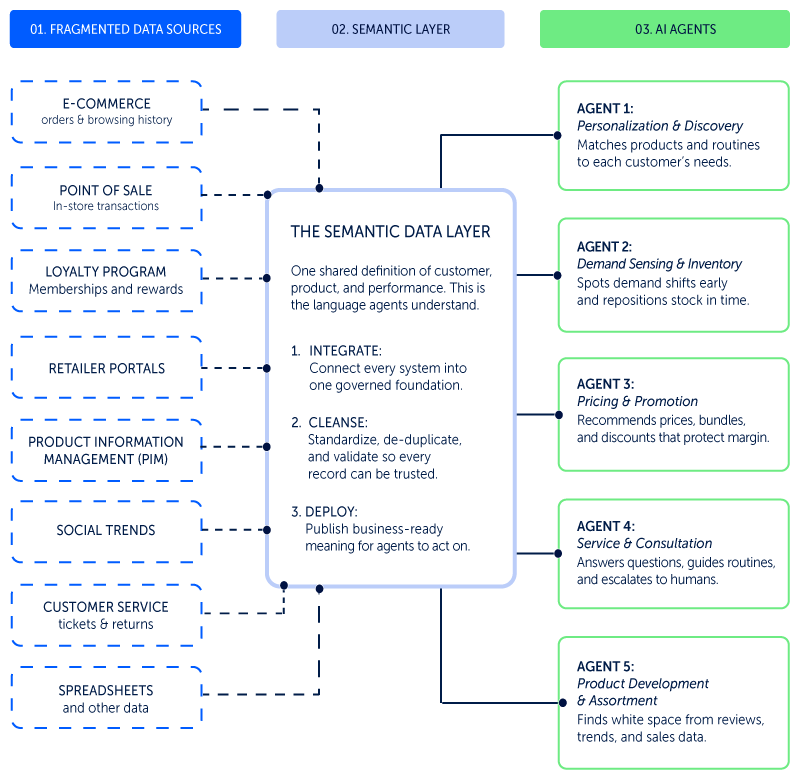
- Personalization and product discovery agents can analyze customer preferences, past purchases, skin or hair concerns, ingredient sensitivities, and channel behavior to recommend products, routines, or replenishment timing. These agents can also adjust recommendations as customers move between e-commerce, social platforms, loyalty apps, and in-store consultations.
- Demand sensing and inventory agents can monitor sales velocity, social trends, influencer activity, weather patterns, regional events, and retailer data to identify demand shifts earlier. For example, an agent could flag a sudden increase in sunscreen demand before a heat wave, recommend inventory transfers to high-demand regions and adjust promotional plans to avoid stockouts.
- Pricing and promotion agents can evaluate margin, competitive pricing, tariff exposure, inventory levels, and customer response to recommend discounts, bundles or price changes by channel. This is especially relevant as beauty brands manage rising landed costs, increased packaging expenses, and more value-conscious shoppers.
- Customer service and consultation agents can answer product questions, guide shoppers through routines, triage returns, support subscription changes and escalate sensitive issues to human teams. When connected to order, loyalty and product data, these agents can create a more consistent experience across digital and physical touchpoints.
- Product development and assortment agents can synthesize customer reviews, ingredient trends, competitive launches, and sales data to identify white space opportunities. They can help teams prioritize formulas, packaging formats, claims and launch timing based on demand signals rather than intuition alone.
Common Challenges
Agentic AI creates value when it is built on strong data, clear governance, and practical use cases. Some common pitfalls for health and beauty companies include:
Fragmented customer and product data.
Beauty data often lives across e-commerce platforms, point-of-sale systems, loyalty programs, retailer portals, product information management systems, social listening tools, customer service platforms, and spreadsheets. Agents need clean, connected data to make reliable decisions.
Trust and transparency concerns.
Customers may welcome personalization, but they also expect brands to be clear about how recommendations are made and how their data is used. This is especially important when recommendations are tied to skin, hair, wellness or appearance-related concerns.
Claims and compliance risk.
Health and beauty brands must be careful that AI-generated recommendations, product content, or service scripts do not overstate efficacy, imply unsupported health claims or create inconsistent messaging across channels.
Bias in recommendations.
Product matching and diagnostic tools must work across diverse skin tones, hair textures, ages, and preferences. Human oversight, representative training data, and routine testing are essential.
Margin pressure and operational complexity.
Tariffs, packaging costs, ingredient availability, and channel fees can change quickly. Without SKU-level profitability visibility, brands risk scaling AI-driven promotions that increase volume but erode margins.
From Disparate Data to AI Agents
AI agents can sense demand, personalize discovery, and protect margin, but only when scattered data is integrated, cleansed, and given one shared meaning they can act on.
Next Steps for Health and Beauty Brands
A focused, staged approach can help brands build confidence while reducing implementation risk. Consider the following steps:
Start with a use case tied to measurable business value.
Prioritize areas such as replenishment, product discovery, promotion planning, customer service or SKU-level profitability where faster decisions can improve conversion, margin, or inventory productivity. Starting with an internal focus allows time to establish critical governance needed before any consumer-facing solutions.
Unify the data that matters most.
Connect product, inventory, customer, content, retailer, and financial data before expanding autonomy. Agentic AI depends on accurate, timely and governed data.
Keep humans in the loop.
Begin with recommendations, then move toward automation once the agent has proven accuracy and teams understand the decision logic.
Define guardrails for customer-facing use.
Establish escalation paths, content review standards, claims guidance, and privacy controls before allowing AI agents to interact directly with shoppers. This is a critical step that requires a thoughtful and measured approach.
Measure both experience and economics.
Track conversion, repeat purchase, returns, service resolution, inventory turns, margin and customer satisfaction so the organization can see where AI is creating durable value.
Scale gradually across channels.
Once one agent proves its impact, extend the framework to adjacent workflows such as loyalty, retail media, assortment planning, or demand forecasting.
The Bottom Line
Agentic AI is not replacing product teams, marketers, beauty advisors, or supply chain leaders. It is becoming the connective layer that helps those teams make faster, more consistent decisions in a market defined by personalization, digital discovery, and operational volatility. For health and beauty brands, the advantage will be with organizations that can combine strong data foundations with clear guardrails and practical agents that improve the customer experience while protecting margin.
By combining robust data infrastructure, large language models, and automation tools, CBIZ Technology works closely with our C&IP leaders to help organizations build intelligent agents that respond proactively to evolving business needs. We work together to establish secure, scalable, AI-ready data architectures so insights are reliable, repeatable and aligned to how the business operates.
This article is part of the Ready, Set, AI – a CBIZ Consumer & Industrial Products AI Impact Series, a program exploring how AI is transforming core sectors within Consumer & Industrial Products.
Ready, Set, AI: How Agentic AI Is Giving Apparel Brands the Forecasting Power of Industry Giants
Ready, Set, AI: How Agentic AI Is Reshaping Today’s Dealerships
Ready, Set, AI: Agentic AI in Manufacturing: Turning Insights Into Coordinated Action
Ready, Set, AI: How AI Agents Are Powering the Future of Health and Beauty
Ready, Set, AI: How Agentic AI is Reshaping Retail
Ready to turn AI into measurable C&IP outcomes, including better forecasts and production scheduling, smarter inventory decisions, and faster response to market shifts?
Connect with CBIZ’s Consumer & Industrial Products and Technology teams to assess your AI readiness. Contact us.
© Copyright CBIZ, Inc. All rights reserved. Use of the material contained herein without the express written consent of the firms is prohibited by law. This publication is distributed with the understanding that CBIZ is not rendering legal, accounting or other professional advice. The reader is advised to contact a tax professional prior to taking any action based upon this information. CBIZ assumes no liability whatsoever in connection with the use of this information and assumes no obligation to inform the reader of any changes in tax laws or other factors that could affect the information contained herein. Material contained in this publication is informational and promotional in nature and not intended to be specific financial, tax or consulting advice. Readers are advised to seek professional consultation regarding circumstances affecting their organization.
“CBIZ” is the brand name under which CBIZ CPAs P.C. and CBIZ, Inc. and its subsidiaries, including CBIZ Advisors, LLC, provide professional services. CBIZ CPAs P.C. and CBIZ, Inc. (and its subsidiaries) practice as an alternative practice structure in accordance with the AICPA Code of Professional Conduct and applicable law, regulations, and professional standards. CBIZ CPAs P.C. is a licensed independent CPA firm that provides attest services to its clients. CBIZ, Inc. and its subsidiary entities provide tax, advisory, and consulting services to their clients. CBIZ, Inc. and its subsidiary entities are not licensed CPA firms and, therefore, cannot provide attest services.