











Agentic AI is moving manufacturers beyond dashboards and recommendations to systems that plan, coordinate, and execute work across the plant and back office. Here’s what’s changing, how to prepare, and where early wins are showing up.
Artificial intelligence has been part of manufacturing for years, improving forecasting accuracy, quality inspections, and maintenance planning. What’s changing now is the rise of agentic AI — systems that don’t just analyze information, but can plan, coordinate, and act across connected workflows. For manufacturers in the Consumer & Industrial Products industry facing margin pressure, labor constraints, and supply chain volatility, this shift has meaningful operational implications.
Used thoughtfully, agentic AI helps organizations respond faster to disruption, eliminate decision bottlenecks, and scale oversight without adding headcount. Used without structure or governance, it can just as easily introduce risk. Understanding how and where to apply agentic AI is now a strategic priority.
What Agentic AI Changes for Manufacturers
Traditional AI helps manufacturers predict outcomes: which machines may fail, which orders could be delayed, or where defects may occur. Agentic AI extends that capability by closing the gap between insight and action. These systems continuously monitor conditions, determine next steps based on predefined goals and constraints, and trigger follow‑on actions across systems.
Manufacturing operations are rarely linear. A late inbound shipment affects production schedules, overtime costs, customer commitments, and cash flow. Equipment performance influences throughput, quality, and safety. Agentic AI is designed to operate across these dependencies, coordinating decisions between planning, maintenance, quality, procurement, and finance rather than treating each function in isolation.
So where should manufacturers start?
Where Agentic AI Is Showing Up First
Many manufacturers begin their agentic AI journey in coordination‑heavy processes rather than fully autonomous production. Early success often comes from workflows where the data already exists, but decisions are slowed by manual review, cross‑team handoffs, and inconsistent quality review.
Common starting points include purchase order exceptions, schedule adjustments, maintenance planning, inventory policy updates, and quality issue triage. These processes tend to be repeatable, rules‑informed, and measurable, characteristics that make them well suited for agent‑driven automation. On the factory floor, agentic AI becomes viable when sensor data, machine logs, and standard operating procedures are consistent and accessible.
High‑Value Use Cases With Illustrative Examples
Adaptive production scheduling is one of the most common use cases. An agent can monitor demand changes, material availability, and capacity constraints, simulate scheduling options, and update plans while escalating only true exceptions to planners.
One mid‑market manufacturer facing frequent schedule disruptions used agentic AI to coordinate supplier updates with production planning. Routine adjustments were handled automatically, allowing planners to focus on constraint management and customer communication.
Predictive maintenance orchestration is another area of impact. Rather than stopping at failure prediction, agents can open work orders, reserve parts, and coordinate downtime with production schedules.
Example 1
A process manufacturer with high-cost downtime used machine logs and maintenance history to trigger early warnings. An agent coordinated work orders and parts reservations automatically and flagged only the jobs that conflicted with production commitments. Maintenance leaders reported fewer unplanned outages and improved alignment between maintenance and production schedules.
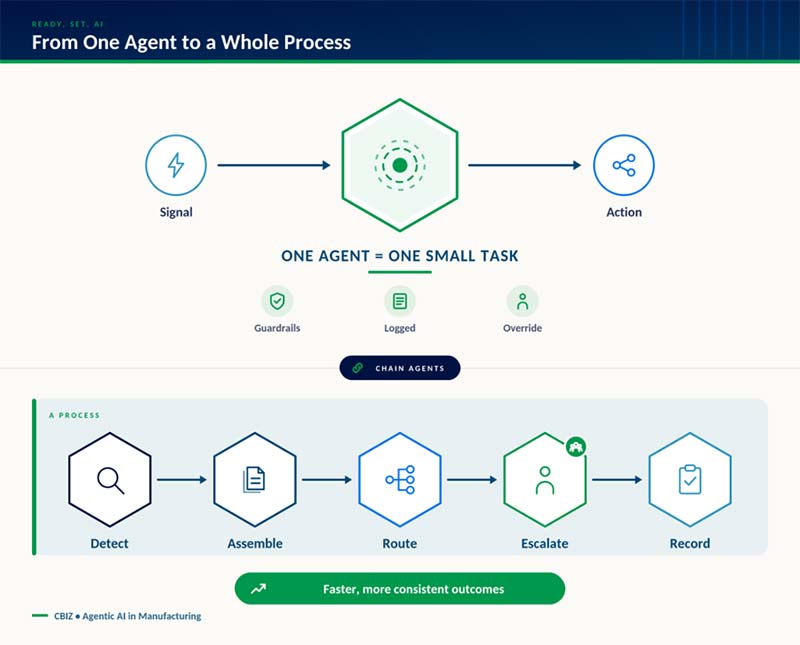
In quality management, agentic AI can assemble inspection data, route nonconformances, and initiate supplier corrective actions, reducing resolution time and administrative effort.
Example 2
An industrial components manufacturer faced delays when quality holds required manual data collection across inspection reports and emails. By centralizing inspection records and SOPs, an agent assembled a standardized “nonconformance packet” and routed it to the right approvers. Quality engineers spent less time compiling documentation and more time on root-cause analysis and prevention.
How Manufacturers Can Take Advantage of Agentic AI
Getting value from agentic AI isn’t about buying a tool—it’s about preparing the organization.
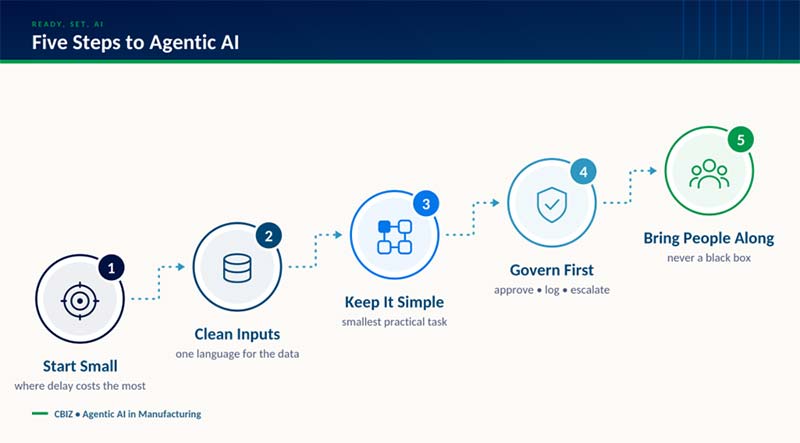
Successful adoption is less about buying an AI feature and more about preparing the organization to use agents safely and effectively. Four steps can keep initiatives grounded and scalable:
Start with one decision loop
Pick a workflow where delays are costly and outcomes are easy to measure – e.g., responding to supplier delays, approving maintenance work, or resolving quality holds. Define the objective (reduce downtime, improve on‑time delivery, lower scrap), the guardrails, and where humans stay in the loop.
Clean up the inputs
Agents are only as reliable as the data and rules they operate on. Standardize master data (parts, suppliers, routings), align definitions (what counts as “late” or “critical”), and improve access to the documents people actually use (SOPs, manuals, work instructions).
Keep it Simple
An Agent should be designed as the smallest task item that can be practically implemented. This is critical for performance, quality and auditability. You can easily combine a series of Agents into a larger process.
Set governance before you scale
Decide what an agent can do automatically, what requires approval, and what must be logged. Include security, privacy, and compliance reviews early, especially if agents can touch pricing, customer data, or controlled technical documentation.
Invest in change management.
Operators, planners, maintenance teams, and finance leaders need to understand how the system makes decisions, how to override it, and how performance will be measured. The quickest way to stall adoption is to treat agents like a black box.
Common Challenges to Expect
One of the most common challenges is integration complexity. Many manufacturing environments rely on a mix of ERP, MES, maintenance systems, spreadsheets, and supplier portals. If agents cannot reliably interact with these systems, they risk becoming another alerting layer rather than a true workflow accelerator. Some prework may be required to enable these source systems for AI-based access. Using Model Context Protocol or MCP is one such technique.
Over‑automation is another risk. Automating unstable or poorly defined processes can amplify existing problems. In addition, unmanaged or ‘shadow’ AI use can introduce security, compliance exposure, and runaway costs. Clear accountability, auditability, and escalation paths are essential to building trust in agent‑driven decisions.
CBIZ Technology partners closely with our C&IP professionals to help organizations address a common barrier to AI success: fragmented, inconsistent data. Together, we combine industry-specific operational knowledge with technology expertise to help manufacturers improve forecasting, inventory management, working capital performance, production planning, procurement decisions, and financial visibility before scaling AI initiatives.
By aligning our efforts, we establish secure, AI-ready data architectures that ensure insights are reliable, repeatable, and fully connected to business operations before scaling agents.
Across industries, our joint approach spans predictive forecasting on Microsoft Fabric and analytics environments that bring together multi-source data into a unified, actionable view. The goal is clear: combine robust data foundations, large language models, and automation to deliver intelligent agents that continuously adapt to evolving business needs.
A Practical Path Forward
Agentic AI represents a fundamental shift in how Consumer and Industrial Product companies operate. The greatest value comes from reducing the lag between identifying an issue and acting on it. If you’re evaluating where to begin, focus on the handoffs that create the most friction today: the approvals, the reconciliations, the exception queues, and the “who owns this?” moments. Those are the places where agents can reduce latency, improve consistency, and free teams to focus on higher-value work.
Ready to turn AI into measurable C&IP outcomes, including better forecasts, smarter inventory decisions, increased operational efficiency, and faster response to market shifts? Connect with CBIZ’s Consumer & Industrial Products and Technology teams to assess your AI readiness.
This article is part of the Ready, Set, AI – a CBIZ Consumer & Industrial Products AI Impact Series, a program exploring how AI is transforming core sectors within Consumer & Industrial Products.
Ready, Set, AI: How Agentic AI Is Giving Apparel Brands the Forecasting Power of Industry Giants
Ready, Set, AI: How Agentic AI Is Reshaping Today’s Dealerships
Ready, Set, AI: Agentic AI in Manufacturing: Turning Insights Into Coordinated Action
Ready, Set, AI: How AI Agents Are Powering the Future of Health and Beauty
Ready, Set, AI: How Agentic AI is Reshaping Retail
Ready to turn AI into measurable C&IP outcomes, including better forecasts and production scheduling, smarter inventory decisions, and faster response to market shifts?
Connect with CBIZ’s Consumer & Industrial Products and Technology teams to assess your AI readiness. Contact us.
Frequently Asked Questions
Agentic AI goes beyond analyzing data. It can plan, coordinate, and act across connected workflows to help manufacturers respond faster and operate more efficiently.
Many organizations start with coordination-heavy processes such as purchase order exceptions, production schedule adjustments, maintenance planning, inventory policy updates, and quality issue triage.
When implemented thoughtfully, agentic AI can reduce decision bottlenecks, improve response times, automate routine adjustments, and help teams focus on higher-value work.
Start with a single, measurable workflow, improve data quality and accessibility, keep agents focused on specific tasks, establish governance policies, and invest in change management.
Common challenges include integrating agents with existing systems, automating poorly defined processes, and managing security, compliance, accountability, and governance risk.
© Copyright CBIZ, Inc. All rights reserved. Use of the material contained herein without the express written consent of the firms is prohibited by law. This publication is distributed with the understanding that CBIZ is not rendering legal, accounting or other professional advice. The reader is advised to contact a tax professional prior to taking any action based upon this information. CBIZ assumes no liability whatsoever in connection with the use of this information and assumes no obligation to inform the reader of any changes in tax laws or other factors that could affect the information contained herein. Material contained in this publication is informational and promotional in nature and not intended to be specific financial, tax or consulting advice. Readers are advised to seek professional consultation regarding circumstances affecting their organization.
“CBIZ” is the brand name under which CBIZ CPAs P.C. and CBIZ, Inc. and its subsidiaries, including CBIZ Advisors, LLC, provide professional services. CBIZ CPAs P.C. and CBIZ, Inc. (and its subsidiaries) practice as an alternative practice structure in accordance with the AICPA Code of Professional Conduct and applicable law, regulations, and professional standards. CBIZ CPAs P.C. is a licensed independent CPA firm that provides attest services to its clients. CBIZ, Inc. and its subsidiary entities provide tax, advisory, and consulting services to their clients. CBIZ, Inc. and its subsidiary entities are not licensed CPA firms and, therefore, cannot provide attest services.