











Retailers across the Consumer & Industrial Products sector are navigating rapidly changing consumer demands, inventory pressures, and margin challenges. Agentic AI is helping organizations move from a “report-and-react” model to a “sense-and-respond” approach, enabling faster, more coordinated decisions across the business.
Agentic AI refers to systems that can perceive context, reason across multiple signals, and act within defined guardrails. Instead of relying on one-off analyses that live in spreadsheets or dashboards, retailers can deploy small, autonomous AI agents that monitor demand drivers, recommend decisions, and trigger workflows across merchandising, pricing, supply chain, e-commerce, marketing, and stores. The outcome is a retail organization that can adapt faster, operate leaner, execute more consistently, and deliver better customer experiences, without relying on a massive analytics function.
For retailers, the opportunity is especially relevant because the operating environment is defined by constant change. Consumer preferences evolve rapidly, traffic shifts between digital and physical channels, promotions move at an accelerated pace, and inventory decisions must balance margin, availability, fulfillment costs, and customer expectations. Agentic AI gives retailers a way to connect those signals and act while the opportunity still exists.
From One-Off to Always-On
While many retailers have experimented with AI to summarize reviews, track competitor prices, or flag anomalies, the real value emerges only when those insights are embedded in operation workflows. Agentic AI turns discrete tasks into reliable components of a broader operating model that runs independently, every day. Each agent is modest on its own, but together, they form an always-on decision layer that compounds accuracy and speed with every cycle.
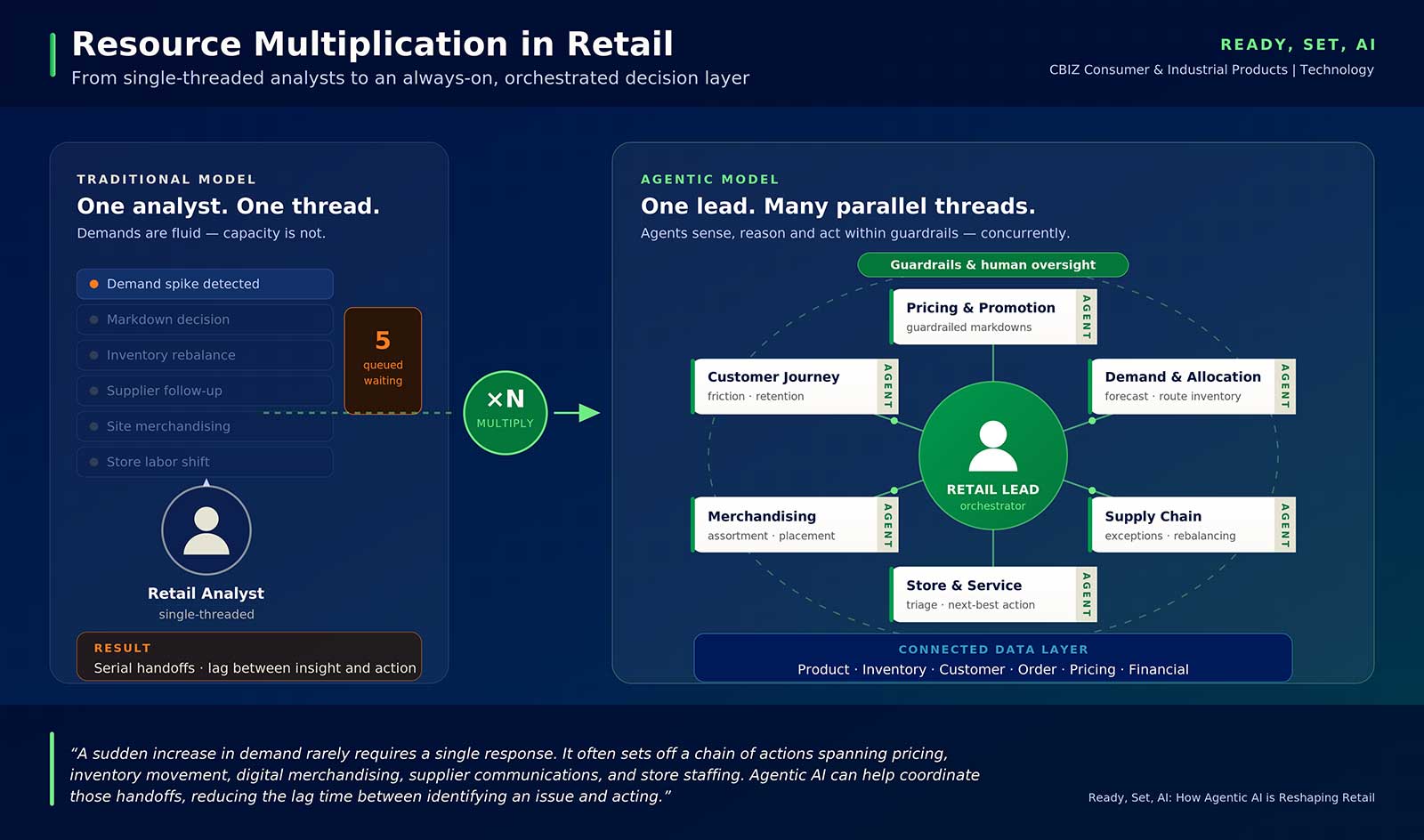
This is significant because in retail, decisions rarely sit neatly within one function. A sudden increase in demand rarely requires a single response. It often sets off a chain of actions spanning pricing, inventory movement, digital merchandising, supplier communications, and store staffing. Agentic AI can help coordinate those handoffs, reducing the lag time between identifying an issue and acting.
Some practical examples of agentic AI that can power this always-on framework include:
- Pricing and promotional agents can continuously evaluate business conditions and adjust recommendations within defined guardrails. Instead of following fixed promotional calendars, retailers can respond to real-time demand and inventory trends, improving sell-through while protecting margin.
- Demand and allocation agents can analyze historical sales, market trends, weather, social sentiment, local events, and fulfillment data to forecast needs and route resources appropriately. For example, an agent could recommend moving inventory to high-performing regions, adjusting replenishment timing, or shifting product visibility online before demand outpaces availability.
- Store and service agents can triage customer issues, answer order questions, recommend next-best actions, and prioritize associate tasks based on traffic, inventory, and service needs. When connected to commerce, loyalty, and product data, these agents can help associates deliver faster, more consistent support across digital and physical touchpoints.
- Merchandising and assortment agents continuously identify assortment opportunities and performance gaps, helping retailers optimize product placement, merchandising, and future planning.
- Customer journey agents can monitor where shoppers drop off, identify friction in search or checkout, recommend personalized content, and trigger retention or replenishment workflows. This can be especially valuable for retailers managing loyalty programs, subscriptions, or omnichannel customer relationships.
- Supply chain and fulfillment agents can flag fulfillment delays, recommend alternate shipping paths, rebalance inventory between stores and distribution centers, and escalate exceptions before they affect the customer experience.
Connecting Siloed Data
One of the most common challenges retailers face when implementing agentic AI is giving agents access to connected, reliable data. Retail data often sits across disconnected systems, limiting an agent’s ability to see the full business context. Clean, connected data allows agents to generate dependable recommendations and coordinate decisions across functions.
Retail was an early adopter of machine learning, one of the earliest forms of AI, because the industry has long relied on statistical models to understand historical patterns and predict future outcomes. Sales history, seasonality, promotion performance, pricing response, customer behavior, store traffic, and inventory movement all contain signals that can inform more accurate forecasts. When those historical patterns are connected across systems, agents can use them to anticipate demand, identify emerging trends, and recommend actions before risks or opportunities appear or risks become visible through traditional reporting.
Maintaining Human Oversight
Maintaining appropriate human oversight is another important consideration when implementing agentic AI in retail. Although agents can accelerate decision-making and automate routine actions, human input remains essential for decisions that could affect customers, brand reputation, legal compliance, or margins. Retailers should start with recommendations, test agent performance, and then gradually introduce automation with clear guardrails.
Ensuring Pricing Fairness and Transparency
Another key challenge retailers may face is ensuring pricing decisions remain fair, transparent, and aligned with customer expectations. AI-enabled pricing introduces potential concerns around fairness and customer trust. Retailers should avoid targeted pricing strategies that could appear discriminatory or create unintended disparities among customers. Clear pricing policies, appropriate communication, and detailed audit trails can help retailers explain how decisions are made and support regulatory compliance.
Agentic AI Implementation Roadmap
A focused, staged approach to implementing agentic AI can help retailers accelerate value while building trust across teams. Consider the following steps:
Start with a decision loop tied to measurable value.
Identify a workflow where delays are costly and outcomes are easy to measure, such as markdown recommendations, allocation changes, replenishment timing, or customer service escalation.
Unify the data that matters most.
Prioritize the product, inventory, customer, order, pricing, and financial data needed for the first use case before expanding to more complex workflows.
Keep the first agent narrow and practical.
Design each agent around a specific task, decision, or handoff. A focused scope makes performance easier to test, explain, and improve.
Define governance before automation scales.
Establish what the agent can do automatically, what requires manager approval, what must be logged, and how teams can override decisions when needed.
Invest in change management.
Merchandising, store operations, marketing, supply chain, finance, and technology teams need to understand how agents make recommendations, how performance will be measured, and how their roles will evolve.
Scale gradually across workflows.
Once one agent proves its impact, extend the framework to adjacent processes such as promotional planning, store labor optimization, fulfillment exceptions, loyalty engagement, or assortment planning.
The Bottom Line
Agentic AI is not replacing retail teams. It is giving them the ability to act with greater speed, consistency, and confidence. Retailers that combine strong data foundations, clear guardrails, and a practical path from recommendation to automation will be best positioned to capture its value. The future of retail will not be defined by who has the most data, but by who can turn that data into coordinated action fastest. This is known as “the multiplier effect.”
By combining robust data infrastructure, large language models, and automation tools, CBIZ Technology helps organizations build intelligent agents that respond proactively to evolving business needs. We work alongside Consumer & Industrial Products leaders to establish secure, scalable, AI-ready data architectures so insights are reliable, repeatable, and aligned to how the business operates.
This article is part of the Ready, Set, AI – a CBIZ Consumer & Industrial Products AI Impact Series, a program exploring how AI is transforming core sectors within Consumer & Industrial Products.
Ready, Set, AI: How Agentic AI Is Giving Apparel Brands the Forecasting Power of Industry Giants
Ready, Set, AI: How Agentic AI Is Reshaping Today’s Dealerships
Ready, Set, AI: Agentic AI in Manufacturing: Turning Insights Into Coordinated Action
Ready, Set, AI: How AI Agents Are Powering the Future of Health and Beauty
Ready, Set, AI: How Agentic AI is Reshaping Retail
Ready to turn AI into measurable C&IP outcomes, including better forecasts and production scheduling, smarter inventory decisions, and faster response to market shifts?
Connect with CBIZ’s Consumer & Industrial Products and Technology teams to assess your AI readiness. Contact us.
© Copyright CBIZ, Inc. All rights reserved. Use of the material contained herein without the express written consent of the firms is prohibited by law. This publication is distributed with the understanding that CBIZ is not rendering legal, accounting or other professional advice. The reader is advised to contact a tax professional prior to taking any action based upon this information. CBIZ assumes no liability whatsoever in connection with the use of this information and assumes no obligation to inform the reader of any changes in tax laws or other factors that could affect the information contained herein. Material contained in this publication is informational and promotional in nature and not intended to be specific financial, tax or consulting advice. Readers are advised to seek professional consultation regarding circumstances affecting their organization.
“CBIZ” is the brand name under which CBIZ CPAs P.C. and CBIZ, Inc. and its subsidiaries, including CBIZ Advisors, LLC, provide professional services. CBIZ CPAs P.C. and CBIZ, Inc. (and its subsidiaries) practice as an alternative practice structure in accordance with the AICPA Code of Professional Conduct and applicable law, regulations, and professional standards. CBIZ CPAs P.C. is a licensed independent CPA firm that provides attest services to its clients. CBIZ, Inc. and its subsidiary entities provide tax, advisory, and consulting services to their clients. CBIZ, Inc. and its subsidiary entities are not licensed CPA firms and, therefore, cannot provide attest services.