










The release of the April Consumer Price Index (CPI‑U) brought unwelcome news for salary planning, with headline inflation running at 3.8% year over year. Let’s discuss why this is an issue and how it should be managed when evaluating future salary increases.
First, it marks the first meaningful disruption to the expectation that wage pressures would continue to cool following the post‑pandemic period of elevated wage growth driven by strong labor demand, constrained workforce supply, and high inflation. For reasons addressed later, increases in CPI tend to lead to increases in rate of wage growth. Returning to the days of 3.0% salary increases looks less likely.
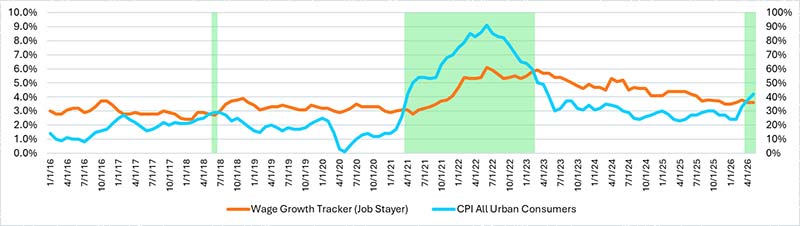
Second, this marks an inversion where inflation exceeds wage growth. The Atlanta Fed Wage Growth Tracker reported overall wage growth of 3.6% for employees who have stayed in the same job. Employees are likely to view increases below the inflation level in poor light.
These two factors bring CPI back into the salary‑planning conversation and raises the question of how, if at all, inflation should influence wage decisions when it runs high.
The Traditional Anchor: Wage Competitiveness
Traditionally, the objective of salary planning has been to maintain competitive positioning in the labor market, not to offset changes in consumer prices. For that reason, wage‑focused measures such as the Employment Cost Index (ECI), the Atlanta Fed Wage Growth Tracker, and Average Hourly Earnings have long served as the primary reference points for salary guidance. These measures are specifically designed to track changes in wages and salaries over time, making them better suited for pay decisions than broad cost‑of‑living indices.
Importantly, this market‑based approach is not inherently unfavorable to employees. Over long periods, wage growth has exceeded inflation, allowing real earnings to rise even without explicit cost‑of‑living indexing. This relationship is illustrated in Chart 1, outside of the post‑COVID period, inflation has exceeded wage growth only once—and only for a single month—over the past decade. In that sense, anchoring salary planning to wage data has historically aligned both competitive and employee interests.
Over the past 10 years, there were 12 months where inflation grew faster than wages. 9 of those months happened after the COVID-19 pandemic.
Why CPI Still Matters
That said, CPI still enters the conversation because it shapes employee expectations, particularly when inflation is elevated. Inflation is visible, widely reported, and personally experienced, leading employees to evaluate pay outcomes through a real‑wage lens—even when market wages are holding steady.
Recognizing this, some well‑intentioned employers factor CPI into salary‑planning discussions as a way to remain credible and responsive to workforce sentiment. The key distinction is how CPI is used: as context for understanding expectations, not as a substitute for wage‑based metrics that are designed to guide competitive pay decisions.
What Is an Employer to Do?
In practice, the response is less about adopting a new framework and more about applying discipline to an existing one:
- Start with competitiveness. The primary goal of salary planning is to keep wages aligned with the labor market, which is why wage‑based data remain the foundation.
- Use inflation as context, not a default input. CPI helps explain employee expectations and perceived outcomes, especially when inflation is elevated.
- Apply judgment before action. Employee expectations, compensation philosophy, internal pay health, and long‑term budget implications all matter.
Then decide. If market data, organizational philosophy, internal pay dynamics, and financial capacity all support doing more to match or offset inflation, that may be an entirely reasonable outcome. The key is ensuring the decision is intentional, market‑informed, and sustainable—not driven by CPI alone.
Contact a CBIZ specialist to better learn how CPI impacts salary planning at your organization.
Frequently Asked Questions
At a minimum, employers should review salary ranges annually. A volatile market may accelerate the need for a comprehensive compensation study.
Yes. One-time payments can provide short-term relief without permanently increasing fixed compensation costs.
Moving too fast can strain budgets, create internal pay gaps, and make future compensation decisions harder to sustain.
© Copyright CBIZ, Inc. All rights reserved. Use of the material contained herein without the express written consent of the firms is prohibited by law. This publication is distributed with the understanding that CBIZ is not rendering legal, accounting or other professional advice. The reader is advised to contact a tax professional prior to taking any action based upon this information. CBIZ assumes no liability whatsoever in connection with the use of this information and assumes no obligation to inform the reader of any changes in tax laws or other factors that could affect the information contained herein. Material contained in this publication is informational and promotional in nature and not intended to be specific financial, tax or consulting advice. Readers are advised to seek professional consultation regarding circumstances affecting their organization.
“CBIZ” is the brand name under which CBIZ CPAs P.C. and CBIZ, Inc. and its subsidiaries, including CBIZ Advisors, LLC, provide professional services. CBIZ CPAs P.C. and CBIZ, Inc. (and its subsidiaries) practice as an alternative practice structure in accordance with the AICPA Code of Professional Conduct and applicable law, regulations, and professional standards. CBIZ CPAs P.C. is a licensed independent CPA firm that provides attest services to its clients. CBIZ, Inc. and its subsidiary entities provide tax, advisory, and consulting services to their clients. CBIZ, Inc. and its subsidiary entities are not licensed CPA firms and, therefore, cannot provide attest services.